2026-05-29 Handling Unexpected Situations — When Plans Go Sideways
Lesson Overview
- Target Audience: B1+ Japanese Adults (upper-intermediate to lower-advanced), 上級 class. 10 students.
- Time: 90 minutes
- Topic: Handling Unexpected Situations
- Can-Do Category: Transactional
- Main Goal: Students can politely report a problem, request clarification, and negotiate a solution in real-world service and travel situations.
Learning Objectives
By the end of this lesson, students will be able to:
- Open a transactional complaint or problem-report politely using hedged language (B1+ register awareness).
- Ask clarifying questions and request specific options when a plan goes wrong (CEFR B1+ “can deal with most situations likely to arise whilst travelling”).
- Compare and discuss strategies for handling unexpected situations across Japanese and overseas contexts, giving reasons.
Target Language
- Vocabulary/Phrases:
- to sort something out — 解決する/対応する
- a mix-up — 手違い
- I’m afraid… (softener before bad news) — 申し訳ないのですが…
- Would it be possible to…? (polite request) — …することは可能でしょうか
- to look into it — 調べる/確認する
- Discourse focus: Hedging and softening for polite complaints; clarification-seeking questions; turn-taking when interrupting calmly.
Materials
- Whiteboard & Markers
- Monitor/Projector (HDMI to room screen) — MacBook Pro
- Slides
- Roleplay scenario cards (1 teacher set, cut into 6 cards: 3 travel mishaps + 3 daily mishaps)
- Target language reference handout (A4, 10 copies — phrase bank + sentence frames)
- Exit tickets (10 copies, standard 4-question)
Lesson Procedure
Timing Budget (class runs 10:00 – 11:30):
| Phase | Clock |
|---|---|
| Pre-task (Warm-up + Language Focus) | 10:00 – 10:20 (20 min) |
| Main Task Activities (3 activities) | 10:20 – 11:00 (40 min) |
| Post-task FonF | 11:00 – 11:08 (8 min) |
| Wrap-Up | 11:08 – 11:15 (7 min) |
| Exit Ticket | 11:15 – 11:20 (5 min) |
| Transitions / Buffer | distributed — runs out to 11:30 (10 min) |
| Total | 10:00 – 11:30 (90 min) |
PHASE 1 — Pre-Task (20 min) [REQUIRED]
Warm-Up (8 min) — “When Plans Go Sideways”
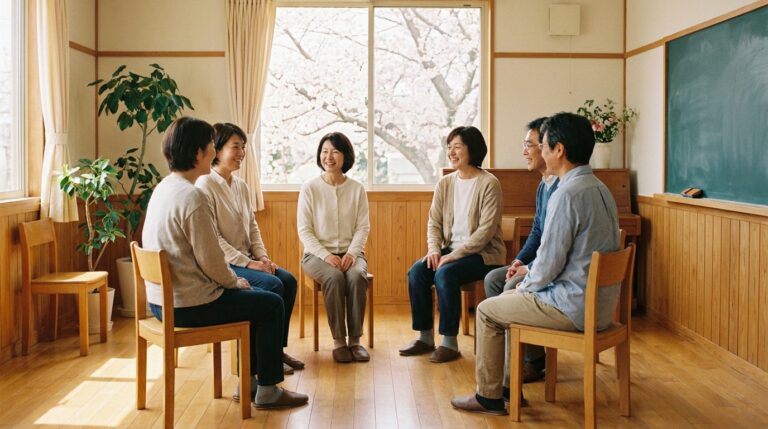
- Activity: Pair past-tense bridge from the May 15 narrative lesson. In pairs, students take turns telling a short story (60 seconds each) about a time something unexpected happened — a missed train, a lost item, a surprise change of plans. Listener asks one follow-up question. Rotate once for a fresh partner.
- CCQs:
- “Are you telling a story from yesterday, or a story from any time in the past?” (any past time)
- “Are you listening only, or also asking a follow-up?” (both — listener must ask one question)
- Form-awareness CCQ: “If you say ‘I have lost my wallet yesterday’ — does that sound right? What would you change?” (Yesterday triggers simple past — I lost my wallet yesterday. Bridges the past-tense recycling.)
Language Focus (12 min) — Phrase Bank Walk-Through
- Activity: Walk through the 5 target phrases on slides. For each one, show the Japanese gloss, model the phrase aloud (twice — once normal, once with stress on the polite softener), and elicit one possible context from the class. Then pairs match 5 phrases to 5 mini-situations on a slide (“My suitcase didn’t arrive” → I’m afraid there’s been a mix-up with my luggage).
- CCQs:
- “Is ‘I’m afraid’ about being scared, or about giving bad news politely?” (giving bad news politely)
- “Would it be possible to…? — is this more polite or less polite than Can I…?” (more polite)
- “When you say sort it out, are you describing the problem or describing the solution?” (the solution)
PHASE 2 — Main Communicative Activities (40 min) [REQUIRED]
Activity 1: Mishap Mingle Survey (~12 min) — MINGLE
- Communicative act: Conducting a quick informal survey by speaking to multiple people in turn — simulates networking conversations and small-talk discovery.
- Steps:
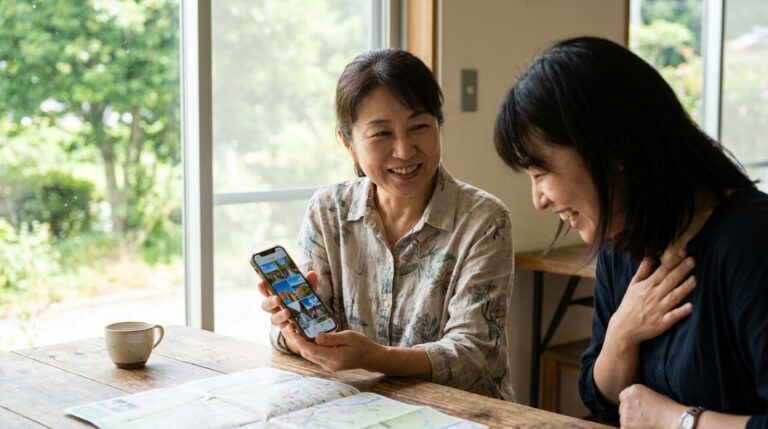
- Each student receives a survey card with 3 questions: “Have you ever lost something while travelling?” / “Have you ever sent food back at a restaurant?” / “What’s the most unexpected thing that’s happened to you on a trip?”
- Students stand and circulate, talking to at least 5 different classmates. They write down one short detail from each conversation.
- After the mingle, sit in groups of 3 and share the most interesting story they heard.
- CCQs:
- “Do you talk to one partner, or to five different people?” (five)
- “Are you writing full sentences, or just a short note?” (short note)
- Mid/post-task form CCQ: “When you asked ‘Have you ever…’ — what verb form came after? Past participle or simple past?” (past participle — present perfect for life experience).
- Extension (for stronger students): After their short note, add a follow-up question that begins “And how did you handle it?” — recycles the lesson’s transactional focus into a fluency mingle.
- Why this activity? Mingling with rotating partners matches students’ stated preference; the survey format gives lower-level students a clear script floor while still requiring genuine information exchange (Ellis: task-essential language use drives uptake).
Activity 2: Service-Counter Roleplay (~14 min) — PAIR ROLEPLAY (Accuracy focus)
- Communicative act: Reporting a problem to a service provider and negotiating a solution — the core transactional task type for this Can-Do category.
- Steps:
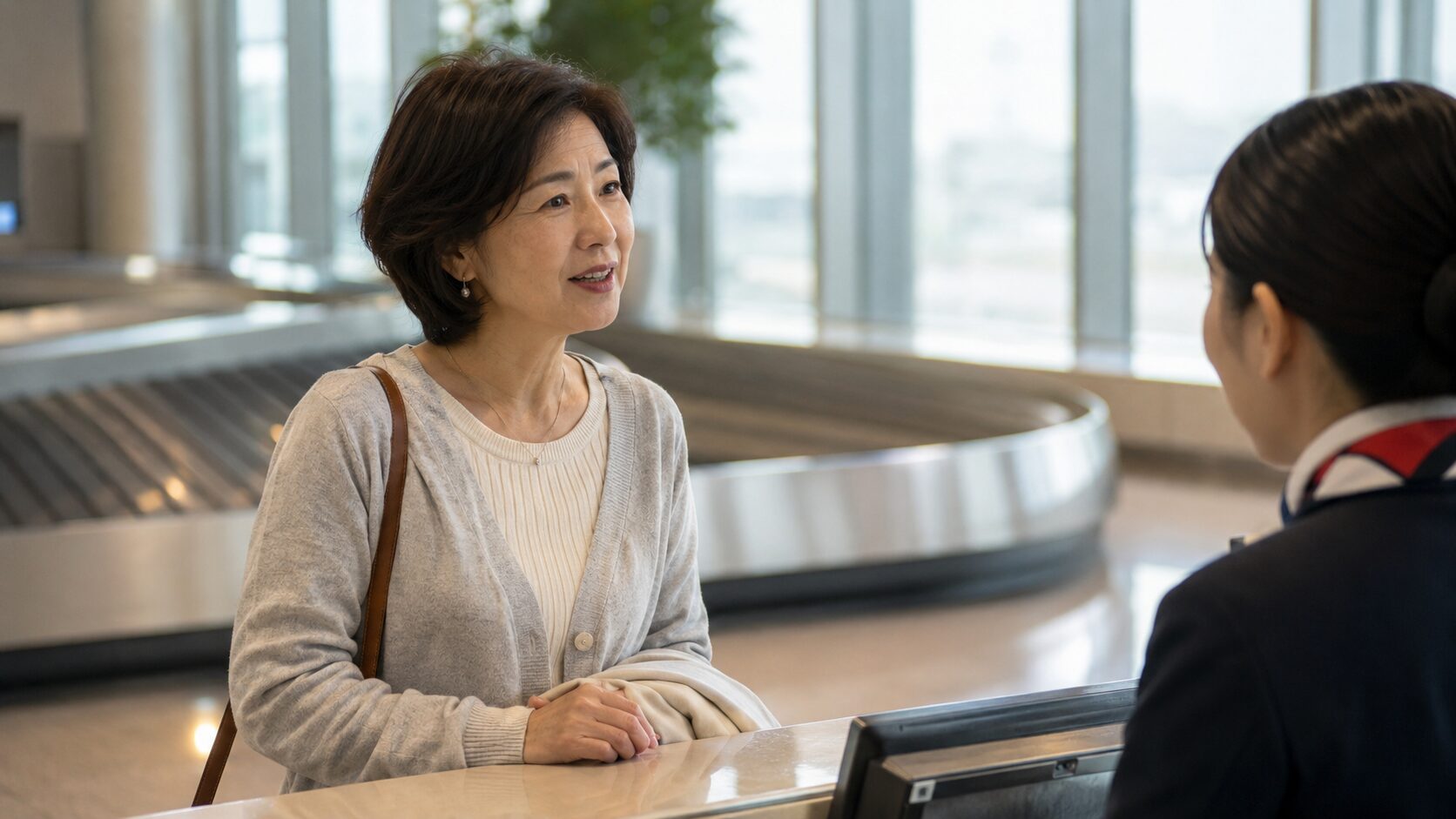
- Distribute 6 scenario cards across pairs (3 travel: lost luggage, missed connecting flight, wrong hotel room; 3 daily: wrong restaurant order, broken appliance returned to store, unexpected schedule change with a service provider).
- Mumbling rehearsal (60 sec): before any live roleplay, students read their card silently and murmur their opening line to themselves. Builds muscle memory and reduces freeze risk for lower-level. (Per Harmer/Scrivener; surfaced in pedagogy-check.)
- Pair A is the customer, Pair B is the staff. Each pair runs one scenario for 3 minutes using the phrase bank from the language focus.
- Swap roles, same scenario, 3 minutes — the second run is for refinement and trying a different phrase.
- Swap to a new scenario card with a new partner. Repeat once more.
- CCQs:
- “When you have the customer card, what’s your goal — to complain loudly or to get things sorted?” (get things sorted)
- “Do you swap roles after the first run, or use a new card?” (swap roles first, then new card)
- Mid/post-task form CCQ: “In your roleplay, did you use ‘I want…’ or ‘Would it be possible to…?’ — which one fits the situation better?” (the polite hedged form; I want is too direct for this register).
- Extension (for stronger students): Staff side introduces a complication (“I’m afraid that flight is fully booked until tomorrow…”) forcing the customer to negotiate a second-best option. Removes the easy resolution scaffold.
- Why this activity? Roleplay with role-swap and scenario-swap allows multiple controlled attempts at the same transactional moves with different content — supports both fluency and accuracy goals (Harmer’s “controlled-to-free” continuum, applied to register practice).
Activity 3: Strategy Ranking & Cultural Compare (~14 min) — GROUPS / DISCUSSION (Fluency focus)
- Communicative act: Group consensus-building — comparing approaches to a shared problem and explaining preferences with reasons.
- Steps (pyramid scaffolding — individual → pair → group):
- Each student receives a slip with one mishap (“Your suitcase didn’t arrive at the airport — what’s your first move?”) and 5 possible strategies (e.g., speak to the airline desk immediately / call your insurance / take photos of your baggage tag / wait 30 minutes to see if it appears / post on social media tagging the airline).
- Individual think-time (1 min): silent ranking on the slip. Lets B1+ learners build their own reasoning before having to defend it aloud. (Per Ur/Scrivener Pyramid Discussion; surfaced in pedagogy-check.)
- Pairs (2 min): compare rankings, agree on a joint top and bottom choice with one reason each.
- Groups of 4 (3 min): pairs merge, negotiate a single group ranking. Use “I’d rather… because…” and “I don’t think… would help much because…”.
- One student from each group shares the group’s top strategy with the class (~30 sec each). Brief comparison: would the answer change if this happened in Japan vs overseas?
- CCQs:
- “Are you choosing your own personal answer, or finding one your group agrees on?” (group consensus)
- “Do you need to explain only the top choice, or top and bottom?” (both top and bottom)
- Mid/post-task form CCQ: “When you disagreed in your group, did you use ‘You’re wrong’? What softer phrase could you use?” (e.g., I see what you mean, but… / That’s a good point, though…).
- Extension (for stronger students): Group must reach unanimous agreement (not majority), forcing more negotiation moves and concession language.
- Why this activity? Ranking with reasons is preference-with-reason framing (v1.9 explicitly preferred over open hypothetical speculation), and the Japan-vs-overseas compare leverages students’ stated interest in cultural differences while keeping the cognitive load grounded in the lesson topic.
PHASE 3 — Post-Task Focus on Form (8 min) [REQUIRED]
Process:
- During Activities 1–3, silently note 2–3 recurring errors on a slip of paper (likely candidates for this topic: missing article in “I have problem”, overuse of want instead of would like, present-tense slips when narrating past mishaps).
- Write the errors anonymously on the board.
- Ask: “What’s the problem here? How would you say it more politely / more accurately?”
- Class identifies and corrects together. Add a brief metalinguistic note (e.g., “In English, abstract problems usually need an article — ‘I have a problem with my room.'”).
- Highlight 1–2 examples of strong language overheard (“I noticed [phrase] working really well in the roleplays — that’s exactly the register we want.”).
Teacher notes template:
Error 1: _______________
Error 2: _______________
Error 3 (optional): _______________
Strong language observed: _______________
Recast note: For mid-activity recasting, use emphatic stress on the corrected form (e.g., student: “I want to change my room” → teacher: “Ah, you’d like to change your room — I’ll see what I can do.”). The post-task FonF carries primary correction load.
Wrap-Up (7 min)
- Lesson Recap: Round-robin — one phrase from today’s lesson each student wants to remember and a quick reason. Allow 30 seconds of silent think time before the round begins (supports lower-level students).
- Preview: “In two weeks (June 12), we’ll move into descriptive language — talking about places and spaces you know well. Start noticing places this week that you’d enjoy describing.”
- Distribute exit tickets.
Exit Ticket (5 min — paper handout, 10 copies)
- What did you talk about today?
- What new word or expression do you want to remember?
- Is there a topic you would like to try in a future lesson?
- How was today’s level for you? Too easy / Just right / A bit difficult
After class: enter Q3 topic requests into _topic-tracker.md and Q4 difficulty data into _exit-ticket-data.md.
Instructor Guidance & Notes
Error Correction Strategy:
- During fluency activities (mingle + group ranking): silent notes only. Do not interrupt.
- During the accuracy-focused roleplay (Activity 2): low-intrusion recasts with emphatic stress are appropriate, especially on the target polite-register chunks.
- Post-task FonF (“Focus on Form”): 2–3 anonymous errors on board, class corrects together, brief metalinguistic note. Celebrate 1–2 strong examples by name of phrase only (not student name).
Differentiation for B1+ class:
- Lower-level students: keep them paired with steady classmates in Activity 2; allow them to use the printed phrase bank openly during the first roleplay run.
- Higher-level students: apply the extension in each activity.
- Activity 3’s ranking format suits one student’s preference for structured tasks over open-ended creativity.
- New student: observe how she handles the mingle and the role-play — note for the intake update after class.
Cultural Sensitivity:
- Frame “handling unexpected situations” as a practical skill, not a personality test. Some students may be uncomfortable with assertive complaint registers; the phrase bank is built around softened, polite forms specifically for this reason.
- During cultural comparison in Activity 3, do not position one culture’s approach as “better” — both Japan-style indirect handling and overseas-style direct request have communicative validity.
Backup Activity:
“Two Truths and a Mishap” — students think of 3 unexpected things that have happened to them. 2 are true, 1 is invented. Class asks 3 questions before guessing which is the lie. 5–10 minutes, no materials required, recycles the lesson’s past-tense and clarification-question target language.
Accessibility & Anxiety Reduction Standards
Cognitive Load Management: Max 3 sentences per paragraph; bullets for lists; clear H2/H3 headings.
Heading Hierarchy: H1 = lesson title and main activity names. H2 = section titles, instructions. H3 = subsections.
Language Complexity: Plain English in all instructions. Active voice. Short sentences in Japanese where present.
Japanese Glosses: Target vocabulary above carries Japanese glosses. Category vocabulary (travel, restaurant, service) and task instructions do not.
Anxiety-Reducing Language:
- Avoid: “test”, “evaluation”, “grading”, “hurry”
- Use: “let’s check understanding”, “feedback”, “take your time”
Suggested Supporting Materials Content
Roleplay scenario card content (6 cards, single A4 sheet, teacher cuts):
| # | Setting | Customer situation | Staff role |
|---|---|---|---|
| 1 | Airline desk | Suitcase didn’t arrive on the carousel; you have an evening event tonight | Ground crew at lost-baggage counter |
| 2 | Airline desk | Connecting flight cancelled; you need to be at a wedding tomorrow morning | Airline gate agent |
| 3 | Hotel front desk | Room is on the ground floor next to the elevator; you booked a quiet high floor | Front desk receptionist |
| 4 | Restaurant | The dish arrived but is not what you ordered; you’re on a tight lunch break | Restaurant server |
| 5 | Electronics store | Coffee maker stopped working after one week; you have the receipt | Customer service desk |
| 6 | Dentist’s office | The receptionist called to move your appointment 2 hours earlier — you’ll miss it | Dental clinic receptionist |
Target Language Reference handout (A4, 10 copies):
- Top half: 5 target phrases with Japanese glosses + 1 example each
- Bottom half: sentence frames grouped by function — Opening politely / Asking for clarification / Suggesting an alternative / Confirming and closing
Backup Activity
Name: Two Truths and a Mishap
Time: 5–10 minutes
Connection: Recycles past-tense narration and clarification-question forms from today’s lesson. Students invent 3 unexpected events (2 true, 1 false); class asks 3 questions before guessing the lie.