
Things We Keep: Keep It or Get Rid of It? (Tradition vs. Efficiency)
Lesson Title: Keep It or Get Rid of It?
Lesson Overview:
- Target Audience: CEFR B1 Japanese Adults (Middle-aged/Older, regular members)
- Time: 90 minutes
- Topic: Deciding whether traditional or aging items should be kept or discontinued (Usefulness vs. Sentiment).
- Main Goal: To enable students to confidently express and justify opinions about everyday items, balancing practical utility with emotional value, using B1-level discourse strategies.
Learning Objectives:
By the end of this lesson, students will be able to:
- Express opinions on whether specific items (e.g., fax machines, hanko) should be kept or discarded.
- Use B1-level vocabulary to describe utility (e.g., practical, obsolete, efficient) and emotion (e.g., sentimental value, fond memories).
- Politely disagree or acknowledge a partner’s point of view during a debate using contrastive structures.
- Justify their choices with at least one clear reason (practical or emotional).
Target Language:
- Focus: Expressing opinions, contrasting ideas, and giving reasons.
- Phrases/Vocabulary:
- Adjectives (B1+): Practical, efficient, obsolete, time-consuming, sentimental.
- Phrases:
- “From a practical perspective…”
- “It has a lot of sentimental value.”
- “It’s a hassle to use.”
- “I see your point, but…”
- “It’s time to move on.”
Materials:
- Whiteboard & Markers
- Projector & Computer
- Obsidian Slides (see outline below)
- Props: Instructor-provided postcards with a real US penny taped to each.
- Handouts: “The Life & Death of the Penny” (Obituary) + “Keep or Toss?” Worksheet (see content below).
- Other: Timer for rotation.
Lesson Procedure:
1. Getting Started (Warm-up) (15 min):
- Purpose: Introduce the theme of “obsolescence vs. value” using a tangible, real-world example (the penny) in an engaging way.
- Activity:The Penny Obituary
- 1. Distribute the postcards with the taped penny to each student.
- 2. Ask students to read the “Obituary” text on the card silently (see content below).
- 3. In pairs, students discuss: Why did the US stop making this? Do you think it’s sad, or a good idea?
- 4. Brief class feedback.
- CCQs:
- “Is the US still making these coins for everyday use?” (No, they stopped).
- “Are we talking about how much money it is, or its history?” (Its history/story).
2. Introducing the Topic/Language Focus (15 min):
- Purpose: Introduce B1 vocabulary for discussing utility and nostalgia.
- Activity: Head vs. Heart
- 1. Draw two columns on the board: Head (Logic/Useful) and Heart (Feeling/Memory).
- 2. Elicit/Teach vocabulary:
- Head: Practical, efficient, time-consuming, obsolete.
- Heart: Sentimental value, tradition, warmth, personal touch.
- 3. Ask: “Which list is the penny in?” (Debate briefly).
- CCQs:
- “If something is ‘obsolete’, do we use it often?” (No).
- “If I keep a ticket stub from a concert, is that for a ‘practical’ reason?” (No, sentimental).
3. Let’s Talk! (Main Activities) (45 min):
- Purpose: Extensive speaking practice with multiple partners, justifying opinions on familiar items.
- Activity 1: Solo Decision (10 min)
- 1. Hand out the “Keep or Toss?” worksheet.
- 2. Students work alone. They must decide for each of the 6 items (Fax, Cash, Nengajo, Receipts, Hanko, CDs/DVDs): Keep or Get Rid Of.
- 3. They must write one keyword reason for each (e.g., “safe,” “waste of paper”).
- CCQs:
- “Do you talk to your partner yet?” (No).
- “Can you choose ‘I’m not sure’?” (No, you must choose one).
- Activity 2: Mingling Debate (Rotations) (35 min)
- 1. Students stand up.
- 2. Round 1: Find a partner. Compare lists. Find one item you disagree on.
- 3. The Task: Debate that one item. Try to convince your partner to change their mind using the target language (“From a practical perspective…”, “But it’s tradition!”).
- 4. Timing: 4-5 minutes per partner.
- 5. Rotate: Change partners. Repeat for 4-5 rounds (filling the time).
- CCQs:
- “If you agree on everything, what should you do?” (Choose the item you both feel strongest about and discuss why).
- “Is the goal just to say your opinion?” (No, try to convince them/negotiate).
4. Wrapping Up (Review & Feedback) (15 min):
- Purpose: Consolidate learning and get feedback.
- Activities:
- 1. Vote Count: Quick show of hands for controversial items (e.g., “Who voted to kill the Hanko?”).
- 2. Error Correction Slot: Write 3-4 anonymous sentences heard during mingling on the board. Ask students to fix them (focusing on opinion phrases or bored vs boring, used to vs use).
- 3. Final Q&A: Opportunity for student questions.
- 4. Exit Ticket: Distribute simple paper questionnaire.
Instructor Guidance & Notes:
- Error Correction Strategy: Delayed. During mingling, carry a notepad; note down errors related to “reasons” (e.g., “It is merit” -> “It has a benefit” / “It is useful”).
- Cultural Sensitivity: “Hanko” and “Nengajo” can be sensitive cultural topics. Ensure the atmosphere remains light and emphasize that there is no “wrong” answer—it’s about personal preference.
- Flexibility: If the “Obituary” reading takes too long, cut one mingling rotation.
- Differentiation:
- Support: Encourage weaker students to stick to one clear structure: “I think we should keep X because Y.”
- Challenge: Ask stronger students to acknowledge the other side before disagreeing: “I understand it has sentimental value, but from a practical perspective…”
Suggested Supporting Materials Content:
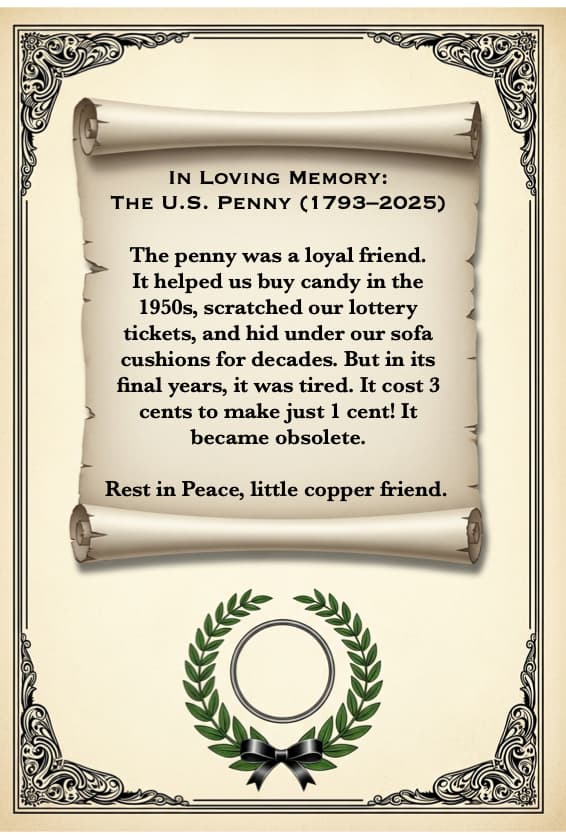
Postcard Text: “The Penny Obituary”
(Print this on card stock or a slip of paper to tape the penny to)
In Loving Memory: The U.S. Penny (1793–2025)
It is with heavy pockets that we announce the passing of the one-cent coin.
Born: 1793 in Philadelphia.
Died: 2025, after a long battle with inflation.The penny was a loyal friend. It helped us buy candy in the 1950s, scratched our lottery tickets, and hid under our sofa cushions for decades. But in its final years, it was tired. It cost 3 cents to make just 1 cent! It became obsolete.
Please keep this penny. It is no longer money. It is now a piece of history.
Rest in Peace, little copper friend.
Worksheet Content: “Keep It or Get Rid of It?”
Instruction: Check ONE box for each item. Be ready to explain WHY.
| Item | Keep It! (It’s important) | Get Rid of It! (It’s time to stop) | My Reason (Keyword) |
|---|---|---|---|
| 1. Fax Machines (in offices) | [ ] | [ ] | ______ |
| 2. Cash (Physical coins/bills) | [ ] | [ ] | ______ |
| 3. Nengajo (New Year Cards) | [ ] | [ ] | ______ |
| 4. Printed Receipts (Paper) | [ ] | [ ] | ______ |
| 5. Hanko / Inkan (Name seals) | [ ] | [ ] | ______ |
| 6. CDs and DVDs | [ ] | [ ] | ______ |
Useful Phrases:
- “From a practical perspective…”
- “It has sentimental value.”
- “It is obsolete (too old/not useful).”
- “It is a hassle (annoying/trouble).”
- “I see your point, but…”
Potential Online Resource Search Terms:
- Google Search: “CBS Sunday Morning history of the penny” (short video context).
- Google Search: “Japan hanko culture decline article simple English” (for background reading).
- Google Search: “Why Japan still uses fax machines BBC” (short video).
Obsidian Slides Outline:
## Keep It or Get Rid of It?

### Usefulness vs. Meaning

![[Pasted image 20260109002927.png|600]]

---

## Warm-up: A Sad Goodbye?

### Please look at the postcard.

### Read the "Obituary" for the Penny.

---

# Vocabulary:
## Head vs. Heart

---

# ==  **Practical**  ==

---
## ==  **Practical**  ==

### Useful, efficient, helps us do things quickly. (The Head)

#### Example: "Email is more **practical** than a letter."

---

# ==  **Sentimental Value**  ==

---

## ==  **Sentimental Value**  ==

### Important because of feelings or memories, not usefulness. (The Heart)

#### Example: "This old watch doesn't work, but it has **sentimental value**."

---

# ==  **Obsolete**  ==

---
## ==  **Obsolete** ==

### No longer used because something newer exists.

#### Example: "Cassette tapes are mostly **obsolete** now."

---

# Activity:
## Make Your Choice

---

## Instructions

- Look at your worksheet.

- For the 6 items (Fax, Cash, Nengajo, etc.), choose **KEEP** or **GET RID OF**.

- You must choose one.

- Write one keyword for your reason.

- **Do not discuss yet!**

---

# Let's Talk! (Mingling)

---

## Rules

- Stand up and find a partner.

- Find **one item** you disagree on.

- Try to convince your partner.

- **Use the phrases:** "From a practical perspective...", "It has sentimental value..."

- Change partners when the timer sounds.

---

# Wrap-up

---

## Which item was the hardest to get rid of?

---

# Exit Ticket

## Please answer the questions on the slip.
Exit Ticket Questions (For Paper Handout):
- 1. What part of today’s lesson did you enjoy the most?
- 2. Was today’s lesson: (Circle one) Too Difficult / Just Right / Too Easy ?
- 3. (Optional) Was the vocabulary: (Circle one) Too Difficult / Just Right / Too Easy ?
- 4. Any other comments or suggestions for future lessons? (Optional: Write in English or Japanese)
Optional At-Home Activities (Low Instructor Effort):
- Digital Detox: Try to go one full day without using cash (use only digital payment) OR try to use only cash for one day. Note how it felt.
- Treasure Hunt: Find one “obsolete” item in your house (e.g., an old camera, a floppy disk) and bring a photo of it next week.
Lesson Plan for Students (Blog Post Version):
- Lesson Topic: Keep It or Get Rid of It? (Tradition vs. Efficiency)
- What we will do: We will look at everyday items in Japan (like Hanko, Fax machines, and Nengajo) and debate whether we should keep them or let them go. We will practice balancing “practical” reasons with “sentimental” feelings.
- Key Phrases/Vocabulary: Practical, Sentimental value, Obsolete, “From a practical perspective…”, “I see your point, but…”
- Handouts: The “Penny Obituary” card and a Discussion Checklist.
- See you in class!
Featured Image Prompt for Blog Post:
A clean, inviting photographic image for a blog post. A diverse group of middle-aged Japanese adults are standing in pairs in a bright classroom, engaged in lively but friendly conversation. One person holds a paper worksheet and is gesturing with a smile, explaining a point. The background is a soft-focus, modern learning environment. The atmosphere is energetic and collaborative. FLUX.1 style.Blog Post Excerpt:
Old traditions or modern efficiency? This week, we discuss the “Life and Death” of the penny and debate the future of items like the Hanko and Fax machine. Join us to practice giving strong opinions and using B1 vocabulary to explain your “Head vs. Heart” choices!
Penny postcard hagaki:
(Figuring out how to get your printer to print it out correctly is left as an exercise for the reader. It worked for me.)