2025-11-07 The Invent-An-Animal Workshop
Lesson Plan: The Invent-An-Animal Workshop (Version 2.0)
Lesson Overview:
- Target Audience: CEFR B1 Japanese Adults (Middle-aged/Older).
- Time: 90 minutes
- Topic: Inventing a new animal.
- Main Goal: To enable students to collaboratively invent, describe, and present a new animal, using appropriate B1-level vocabulary for description and justification in a fun, creative context.
Learning Objectives:
By the end of this lesson, students will be able to:
- Describe a fictional animal’s physical appearance, personality, and special abilities.
- Use target vocabulary related to features and characteristics in conversation.
- Collaborate with a small group to develop a creative concept and agree on details.
- Justify their group’s choices using simple reasoning phrases in a persuasive context.
Target Language:
- Focus: Language for describing features, abilities, and justifying choices.
- Phrases/Vocabulary:
- combination (n.): A mixture of different things.
- feature (n.): An important or noticeable part of something.
- unique (adj.): Being the only one of its kind; very special or unusual.
- harmless (adj.): Not able or likely to cause injury or damage.
- skillful (adj.): Having or showing a special ability or skill.
Materials:
- Whiteboard & Markers
- Projector & Computer
- Obsidian Slides (see outline below)
- Handouts: Invent-An-Animal Worksheet (one per group)
- Other: Small pieces of paper & pens for Exit Tickets
Lesson Procedure:
1. Getting Started (Warm-up) (10 minutes):
- Purpose: To activate existing animal-related vocabulary and practice forming questions.
- Activity: “Animal Guessing Game”
- Put students into pairs (A and B).
- Student A thinks of a common animal (e.g., cat, elephant, penguin).
- Student B asks Yes/No questions to guess the animal (e.g., “Can it fly?”, “Does it live in Japan?”, “Is it bigger than me?”). Student A can only answer “yes” or “no.”
- After Student B guesses correctly, they switch roles. Encourage them to switch 2-3 times.
- CCQs: “Are you working alone or with a partner?” (With a partner.) “What kind of questions should you ask?” (Yes/No questions.) “Can you ask ‘What animal is it?'” (No.)
2. Introducing the Topic/Language Focus (15 minutes):
- Purpose: Introduce the lesson’s creative theme and present the target B1 vocabulary and phrases.
- Activity: “Vocabulary & Concept Introduction”
- Transition from the warm-up: “You are all great at guessing real animals. Today, we are going to invent a new animal!”
- Use the Obsidian slides to introduce the five target vocabulary words: combination, feature, unique, harmless, skillful. Present each word, its definition, and an example sentence. Do a quick check for understanding (e.g., “Is a dog with two heads unique? Yes!”).
- Introduce a few useful phrases for the main activity on a slide: “Our animal is a mix of a…”, “Its most unique feature is…”, “It’s able to…”, “We think it’s a perfect pet because…”.
- Briefly explain the main task: “In small groups, you will create a new animal by combining two real animals. You will use a worksheet to help you organize your ideas.”
- CCQs: “What does ‘combination’ mean?” (A mix of things.) “If something is ‘harmless’, is it dangerous?” (No.) “How many animals will you mix to create your new one?” (Two.)
3. Let’s Talk! (Main Activities) (55 minutes):
- Purpose: Provide structured, extended practice for students to collaborate, create, and use the target language in a meaningful and fun communicative task.
- Activity 1: The “Animal Lab” – Group Brainstorming (35 minutes)
- Divide students into small groups of 3 or 4.
- Give each group one “Invent-An-Animal Worksheet.”
- Explain that they must work together to complete the worksheet. They need to decide on a name, the two animals it’s a combination of, its appearance, personality, a unique ability, and why it’s a great pet or helper.
- Circulate around the room, monitoring, offering help, and listening for errors for delayed correction. Encourage a rich discussion and use of the new vocabulary.
- CCQs: “Are you working alone or in a group?” (In a group.) “What information do you need to write on the worksheet?” (Name, the two-animal mix, ability, etc.) “Will you present this to the other groups later?” (Yes.)
- Activity 2: “Creature Showcase” – The ‘Best Pet’ Pitch (20 minutes)
- Explain that each group will give a short, informal “sales pitch” (2-3 minutes) for their new animal. Their goal is to persuade the class that their creation is the best new pet.
- One person can speak, or they can share the role. They should use their completed worksheet as a guide.
- Encourage the listening students to think like customers. They can ask one simple question for each group (e.g., “What does it eat?”, “Is it expensive?”).
- Manage the time strictly but warmly to ensure all groups have a chance to present.
- CCQs: “How long is your presentation?” (2-3 minutes.) “What is your goal?” (To convince the class our animal is the best pet.) “What should the audience do?” (Listen, and think of a question.)
4. Wrapping Up (Review & Feedback) (10 minutes):
- Purpose: Consolidate learning, address common errors in a supportive way, and gather student feedback.
- Activities:
- Lesson Recap/Fun Vote (2 mins): After all presentations, hold a quick, fun vote based on the sales pitches. Ask: “Which animal would you most like to buy as a pet?” This ends the main activity on a positive, shared note.
- Surgical Error Correction (5 mins): On the whiteboard, write down 2-3 anonymous sentences you heard that contained common, high-impact errors. For example, “It have a unique skill.” Ask the class, “How can we make this sentence better?” and guide them quickly to the correction (“It has a unique skill.”). Keep this part quick and focused.
- Exit Ticket & Final Q&A (3 mins): Ask if there are any final questions. Distribute the small slips of paper for the exit ticket. Students can complete these as the lesson formally concludes.
Instructor Guidance & Notes:
- Error Correction Strategy: Stick to the delayed, surgical correction method. Focus on errors in the use of new vocabulary or core B1-level grammar for description and justification.
- Cultural Sensitivity: This is a highly collaborative and creative task. Foster a supportive atmosphere where all ideas are welcomed. The “fun vote” at the end should be lighthearted, not a serious competition.
- Flexibility: If some groups finish brainstorming early, they can start planning their “sales pitch” or draw a picture of their animal.
- Quality over Quantity: The goal is for students to have a rich discussion and create a well-developed idea, not to rush through the worksheet. Combining two animals instead of three encourages deeper thinking.
- Technology Note: The lesson is tech-light, relying only on the projector for the initial vocabulary presentation.
- Differentiation:
- Support: For students who might struggle, you can pre-teach the animal parts (wings, paws, tail, shell, etc.) or provide a list of animal names on the whiteboard to help with brainstorming.
- Challenge: Encourage stronger students to add more details for their sales pitch, such as the animal’s habitat, diet, or a funny story about it.
Suggested Supporting Materials Content:
Handout: Invent-An-Animal Worksheet
The Animal Lab: Create a New Creature!
Group Members: _____________________________
- Our New Animal’s Name: ____________________________
- It is a combination of which two animals?
- Animal 1: _______________
- Animal 2: _______________
- Appearance & Features: (What does it look like? What is its most interesting feature?)
____________________________________________________- Personality: (Is it friendly, shy, funny, smart?)
____________________________________________________- Unique Ability: (What special, skillful thing can it do?)
____________________________________________________- Why is it a perfect pet or helper? (Is it harmless? Is it helpful? Prepare your sales pitch!)
____________________________________________________
Obsidian Slides Outline:
## The Invent-An-Animal Workshop

### Let's Create a New Creature!

`A clean and simple photographic image for a presentation. A middle-aged Japanese person is smiling gently as they sketch a whimsical, simple animal drawing on a whiteboard. The background is a bright, minimalist classroom, softly out of focus. Conveys creativity and enjoyable learning. FLUX.1 style.`

---

# Warm-up

## Animal Guessing Game

### 1. Work with a partner.

### 2. Partner A: Think of a real animal.

### 3. Partner B: Ask Yes/No questions to guess.

### 4. Switch roles!

---

# Key Vocabulary

---

# combination

---

## == **combination** ==

### A mix of different things put together.

#### Example: A "spork" is a combination of a spoon and a fork.

---

# feature

---

## == **feature** ==

### An important or noticeable part of something.

#### Example: The elephant's most famous feature is its long trunk.

---

# unique

---

## == **unique** ==

### Being the only one of its kind; very special.

#### Example: Her style of painting is very unique.

---

# harmless

---

## == **harmless** ==

### Not able to cause any injury or damage.

#### Example: Most spiders in Japan are completely harmless.

---

# skillful

---

## == **skillful** ==

### Having or showing a special ability.

#### Example: He is a skillful cook; his food is always amazing.

---

## Useful Phrases

### - Our animal is a **combination** of a...

### - Its most **unique feature** is...

### - It is **skillful** at...

### - We think it's a perfect pet because it's **harmless**.

---

# Activity 1: The Animal Lab

## Group Brainstorming

### 1. Make groups of 3-4 people.

### 2. Get one "Invent-An-Animal Worksheet".

### 3. Combine **two animals** to create your new creature!

### You have 35 minutes!

---

# Activity 2: The 'Best Pet' Pitch

## Group Presentations

### 1. Give a short 2-3 minute "sales pitch".

### 2. Persuade us: Why is your animal the BEST pet?

### 3. Listeners: You are the customers. Think of a question!

---

# Wrap-up & Q&A

---

# Exit Ticket

### Please answer the questions on the small paper.

### Thank you for your hard work!
Exit Ticket Questions (For Paper Handout):
- What part of today’s lesson did you enjoy the most?
- Was today’s lesson: (Circle one) Too Difficult / Just Right / Too Easy ?
- Was the vocabulary: (Circle one) Too Difficult / Just Right / Too Easy ?
- Any other comments or suggestions for future lessons? (Optional: Write in English or Japanese)
Optional At-Home Activities (Low Instructor Effort):
- Write a short paragraph (3-4 sentences) giving more details about the new animal your group created.
- Find a picture of a real animal you think is very unique or unusual online and be ready to say one interesting fact about it next week.
Lesson Plan for Students (Blog Post Version):
- Lesson Topic: The Invent-An-Animal Workshop
- What we will do: This week, we’ll use our imagination! In small groups, we will invent a completely new animal by combining two real animals. We will decide on its name, its unique abilities, and its personality. Then, you will present your fun creation to the class and try to convince us it’s the best new pet!
- Key Phrases/Vocabulary:
- combination
- feature
- unique
- harmless
- skillful
- Handouts: We will use a worksheet to help us organize our ideas.
- See you in class!
Featured Image Prompt for Blog Post:
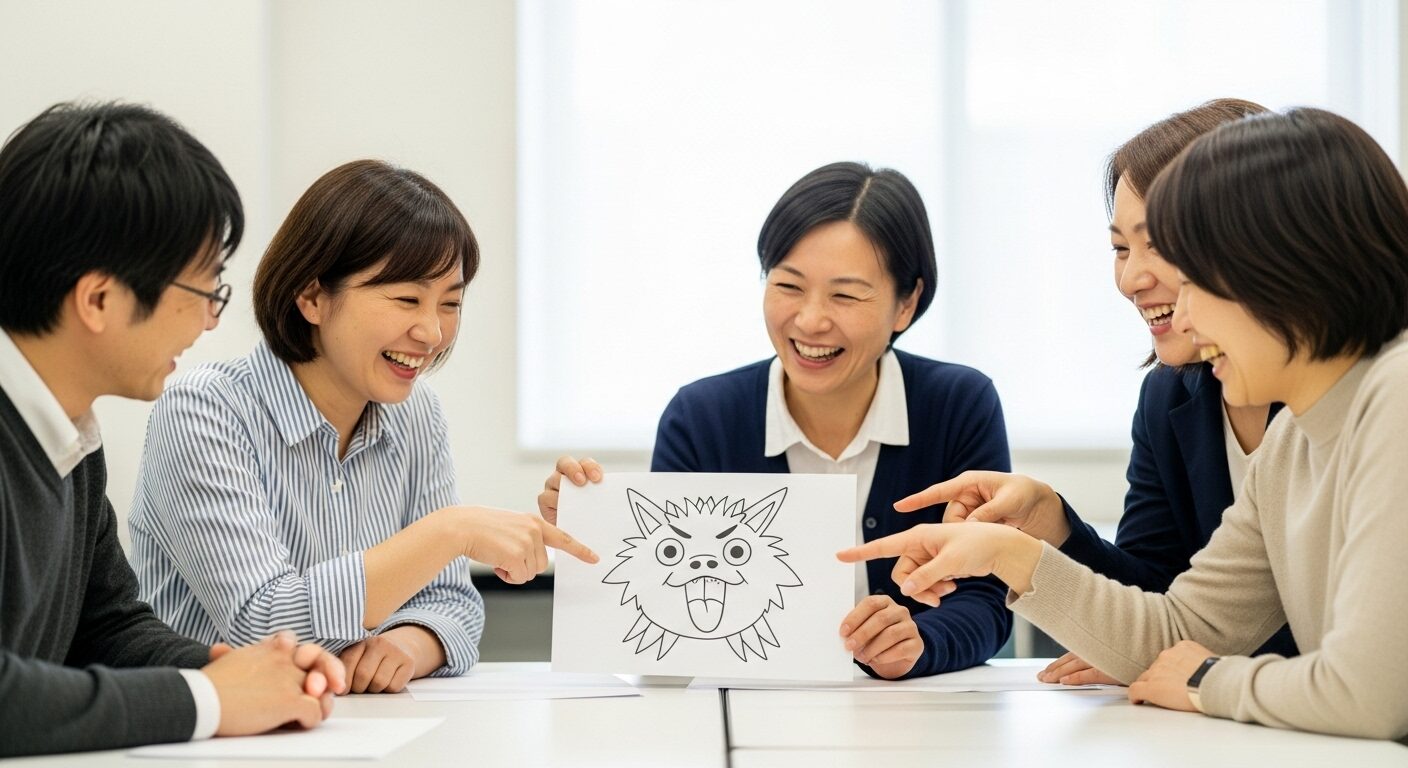
A bright and inviting photographic image for a blog post. A small group of middle-aged Japanese adults are gathered around a table, laughing and pointing at a simple, funny drawing of a fantasy animal on a piece of paper. The atmosphere is collaborative and joyful. The setting is a clean, modern classroom with soft, natural light, and the background is pleasantly blurred. FLUX.1 style.Blog Post Excerpt:
Ready for some creative fun? This week, we’re moving beyond the real world to invent our very own perfect animals! By combining two different animals, we’ll practice using descriptive B1 vocabulary and work in teams to bring our unique creatures to life. Come ready to brainstorm, laugh, and share your amazing ideas.
Pages: 1 2